Natural stone glossary: marble and slab terms explained
The stone trade has a language of its own. These are the terms you will hear most when choosing, ordering or specifying marble, quartzite or onyx, in alphabetical order and in a few words.
A
- Absorption
- How much water a stone takes up, as a percentage of its weight (EN 13755). The lower it is, the less the stone stains.
- Alabaster
- A white, translucent stone, softer than marble. Used for lamps, sculpture and backlit indoor features.
- Anchor
- A metal fixing that holds a panel to a wall or subframe. On ventilated façades: kerf (slot), pin or undercut anchors.
B
- Backlighting
- Lighting a translucent stone from behind: onyx, alabaster, some quartzites and many semi-precious slabs. See backlit onyx.
- Block
- A squared piece of stone weighing several tonnes, straight from the quarry, from which slabs are cut. We also sell whole blocks.
- Book-match
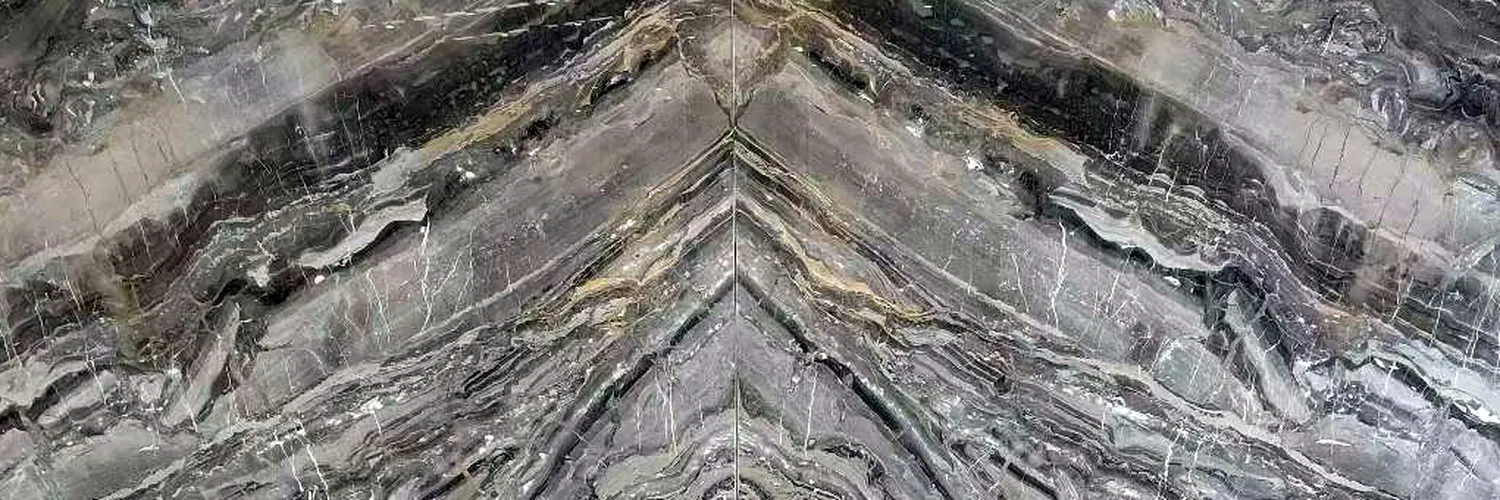
- Consecutive slabs from the same block laid out like an open book, so the veining forms a mirror image. See what is bookmatching.
- Bowing
- The warping that thin panels of some marbles can develop outdoors through cycles of heat and moisture (EN 16306 test).
- Breccia
- A stone of broken rock fragments naturally cemented back together, such as Breccia Pontificia.
- Brushed
- A finish made with abrasive brushes that softens the surface and edges and gives a worn look.
- Bush-hammered
- A rough, pitted finish made with a bush hammer (a hammer with a toothed head). Very slip-resistant.
C
- CE marking
- The EU mark for construction stone products covered by a harmonised standard (EN 1469, EN 12057, EN 12058, EN 1341, 1342 and 1343), with its DoP. See how to specify natural stone.
- Cladding
- Covering a wall with stone panels. See interior stone wall cladding.
- Crystallization
- A chemical shine treatment for polished marble floors, applied with a rotary machine and steel wool. Only for calcareous stones.
D
- Declaration of Performance (DoP)
- The document that goes with CE marking and states the product's tested values.
- Density
- Weight per volume (EN 1936). Marbles, quartzites and granites are around 2,600–2,800 kg/m³ (162–175 lb/cu ft): a 2 cm (¾ in) slab weighs about 52–56 kg/m² (about 11 lb/sq ft), a 3 cm (1¼ in) slab about 78–84 kg/m² (16–17 lb/sq ft).
- Dolomitic marble
- Marble made of dolomite, somewhat harder and less acid-sensitive than calcitic marble. Some white stones sold as quartzite are dolomite.
- Dry lay
- Laying out slabs or pieces unfixed, before cutting or installing, to check how the veining flows.
E
- Edge profiles
- The shape of the visible edge: eased (square, arris softened), bevelled (a small chamfer), half bullnose (rounded on top, flat below), full bullnose (fully rounded) or mitred. See countertop thickness.
- Engineered quartz
- A manufactured material of crushed quartz and resin. It is not natural stone. See quartzite vs quartz.
- Etching
- The dull mark lemon, vinegar or wine leave on marble, limestone or onyx by dissolving the calcite. It is damaged surface, not dirt. See marble etching.
F
- Fabricator
- The workshop that turns slabs into finished pieces and usually installs them (in the UK, often the stonemason). They template the job and prepare the slab layout.
- Finish
- The treatment of the visible face: polished, honed, leathered… It changes colour, sheen, feel and slip resistance. See natural stone finishes.
- Flamed
- A rough finish made with a very hot flame. Only for granite and some quartz-rich stones, never for marble.
G
- Gang saw
- A machine that cuts a block into many slabs at once, with parallel steel blades or, in multi-wire saws, diamond wires.
- Granite
- An igneous rock of quartz, feldspar and mica, very hard. The trade also gives the name to other similar hard rocks.
H
- Honed
- A smooth, matt finish: polishing stops before the shine. It hides everyday marks.
L
- Leathered
- A brushed finish that follows the softer areas of the stone, leaving a gentle relief, a satin sheen and a leather-like feel. Hides fingerprints and water spots.
- Limestone
- A sedimentary rock of calcium carbonate, often with fossils. Acid-sensitive, like marble. Example: Belgian Blue.
- Lot
- Slabs from the same block, numbered in cutting order (also called a bundle). Buying from one lot keeps colour and pattern consistent.
M
- Marble
- A metamorphic rock of recrystallised calcite (or dolomite). It takes a high polish but is soft and acid-sensitive. See types of marble.
- Mesh backing
- Fibreglass mesh bonded with resin to the back of a slab to reinforce fragile stones such as onyx.
- Mitre (miter)
- Two pieces cut at 45° and joined. It gives clean corners and edges that look solid.
- Mohs hardness
- Scratch resistance on a 1-to-10 scale. Calcite, in marble, rates 3; quartz, in quartzite, rates 7: a knife scratches marble but not quartzite.
O
- Onyx
- A banded, translucent calcite stone, soft and acid-sensitive. It usually has mesh and resin on the back.
P
- Patina
- The look marble takes on after years of use: small marks and a softer sheen.
- Polished
- A glossy, mirror-like finish. It deepens colour and veining; on marble it makes etch marks more visible.
- Porosity
- The percentage of voids inside a stone (EN 1936). The more porous, the more it absorbs.
- Primary block
- The first huge, irregular mass freed from the quarry face, later divided and squared into blocks. Spanish quarries call it a torta.
Q
- Quarry
- The place where stone is extracted, open-cast or underground.
- Quartzite
- A metamorphic rock of fused quartz grains. Much harder than marble and far more resistant to acids. See marble vs quartzite.
R
- Resin treatment
- Filling pores, hairline cracks and voids with resin at the factory, before polishing. Common in quartzites, breccias, onyx and travertine.
S
- Sandblasted
- A fine, slip-resistant texture made by blasting sand or grit at the surface.
- Sealing
- An impregnator that slows the absorption of water and oil. It does not protect against acids. See do you need to seal marble?
- Semi-precious slab
- Pieces of amethyst, sodalite or another semi-precious stone bonded with resin and polished on a backing panel. Not a solid block. See exotic and semi-precious stone.
- Serpentine
- A dark green rock sold as green marble, such as Verde Alpi. Moisture-sensitive during installation, so epoxy or polyurethane adhesives are usually recommended.
- Slab
- A large sheet cut from a block, usually 2 or 3 cm (¾ or 1¼ in) thick. The unit stone is sold and chosen by.
- Slab layout
- A drawing showing which slab, and which part of it, each piece comes from. See large-format slabs and slab layout.
- Slip resistance
- How well a floor resists slipping. Spain and the UK use the pendulum test (Rd, PTV); the US uses DCOF. See natural stone slip resistance.
T
- Travertine
- A limestone deposited by spring water, with characteristic holes that are filled or left open.
V
- Vein
- A line or band of another colour running through the stone and giving it character.
- Vein-cut and cross-cut
- The two ways of cutting a block relative to its layers. Vein-cut gives a striped pattern; cross-cut (or fleuri) a cloudy, more uniform one. The terms get mixed up, so describe the pattern or ask for photos.
- Ventilated façade
- Panels hung from a metal subframe with concealed anchors, a ventilated cavity and outside insulation (a rainscreen). See ventilated stone façade.
W
- Waste
- The material lost when the pieces are cut. It depends on the slab layout and is higher with book-matching.
- Waterfall
- A countertop or island where the stone runs down the side to the floor, mitred so the veining carries on. See waterfall countertop.
- Wire saw
- A steel cable threaded with diamond beads. It cuts stone in the quarry and blocks in multi-wire saws.
Unsure about a term in your project? Browse the catalogue and tell us what you need: we will send photos and videos of the actual slabs, and we ship worldwide.
Have a project in mind?
Ask us for a no-obligation quote: we will reply with an indicative price.