What is bookmatching in marble and how to use it
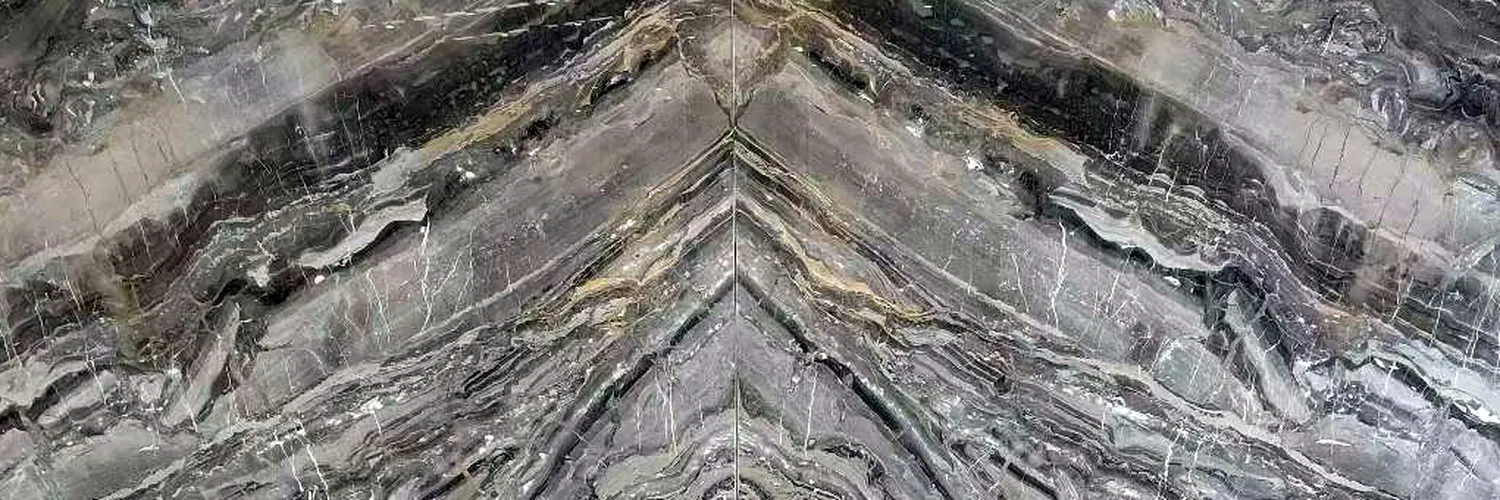
You have probably seen marble walls with a perfectly symmetrical pattern, like an ink blot folded in half. That is bookmatching, one of the most spectacular ways to use natural stone.
What it means
When a block of stone is sawn into slabs, the slabs come out one after another, like the pages of a book. Two consecutive slabs have almost the same pattern. Flip one of them and place them side by side, and the veining mirrors itself, creating a symmetrical design.
Our catalogue has many examples: Orobico Grey forms a herringbone, Blue Roma draws a kind of butterfly and Patagonia creates an almost symmetrical crystal figure.
Why it is possible
Because the slabs are cut in sequence from the same block, with a blade only a few millimetres thick between them. The veining runs through the block in three dimensions, so it changes very little between neighbouring slabs. For one slab to show the "mirror face", it has to be polished on the opposite side to its neighbour — something decided at the workshop.
Types of matching
- Bookmatch: two slabs mirrored vertically. The most common.
- Quad match: four slabs mirrored horizontally and vertically, forming a central motif. Popular on large walls and floors.
- Slip match (continuous vein): slabs placed in sequence without flipping, so the veining flows as if it were one piece.
Where to use it
- Feature walls in living rooms or receptions.
- Showers and bathroom walls.
- Waterfall kitchen islands: the veining can flow from the top down the side.
- Floors in large spaces, with quad patterns.
What to consider when ordering
- You need consecutive, numbered slabs from the same block. Any slab of the same stone will not do.
- Material yield is lower: to make the pattern match, part of a slab may have to be sacrificed. It can add cost.
- Decide before cutting and mark the axis of symmetry on the drawings.
- Strongly veined stones (Orobico, Calacatta Viola, Blue Roma) look far more striking than uniform ones.
Want a bookmatch? Ask us which stones have consecutive slabs available. Get a quote.
Have a project in mind?
Ask us for a no-obligation quote: we will reply with an indicative price.