Breccia Pontificia marble: what it looks like, choosing the slab and where to use it
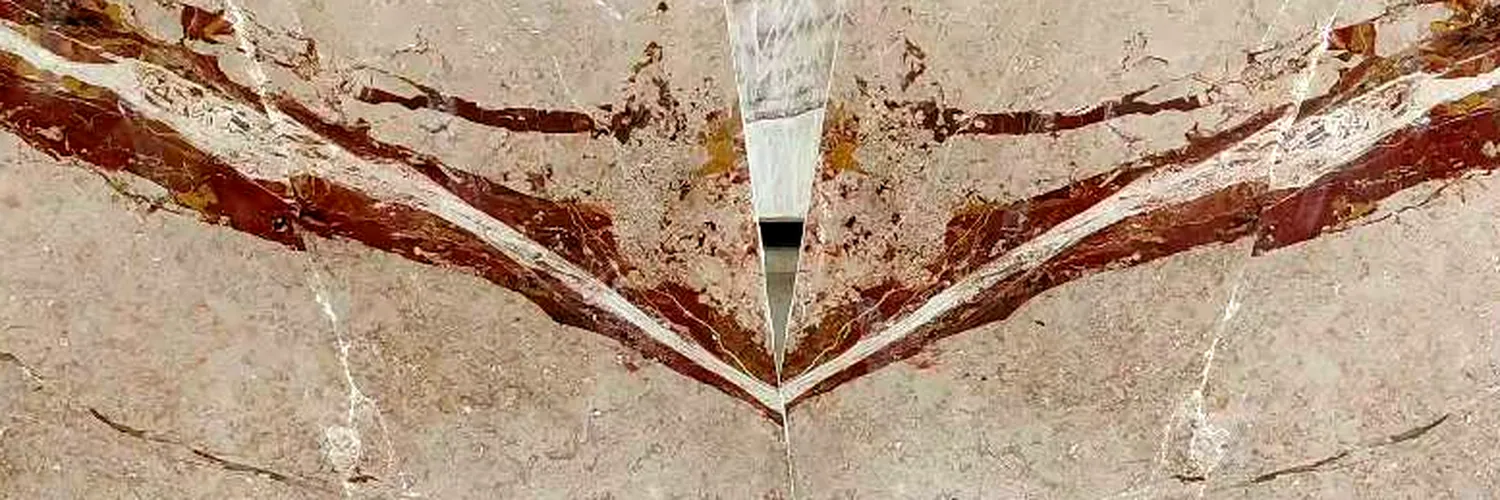
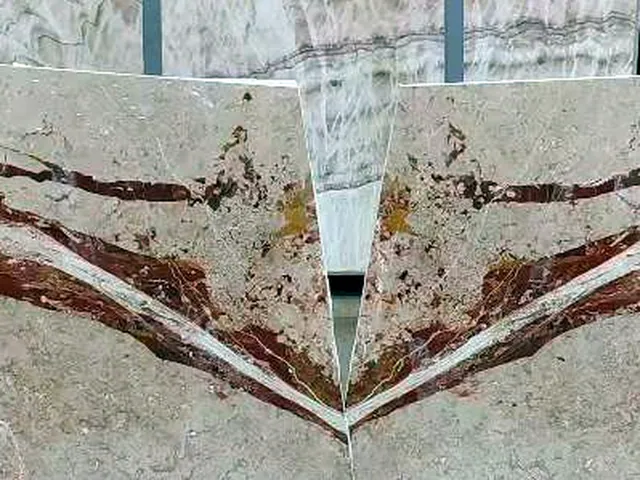
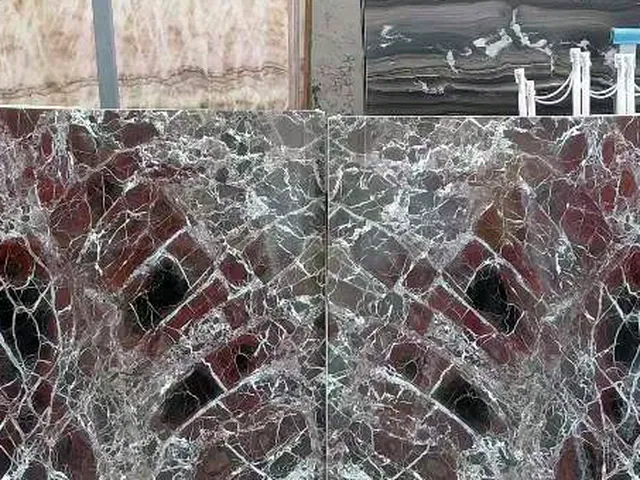
Breccia Pontificia is one of those marbles nobody walks past: a light background crossed by large wine-red, rust and grey veins. Bookmatched, it draws a V that looks like a pair of wings. Here is what it is like, how to choose the slab and where it really shines.
Real slabs in our stone library. Tap + to save the ones you like and ask for photos and a quote for all of them at once.
What Breccia Pontificia is
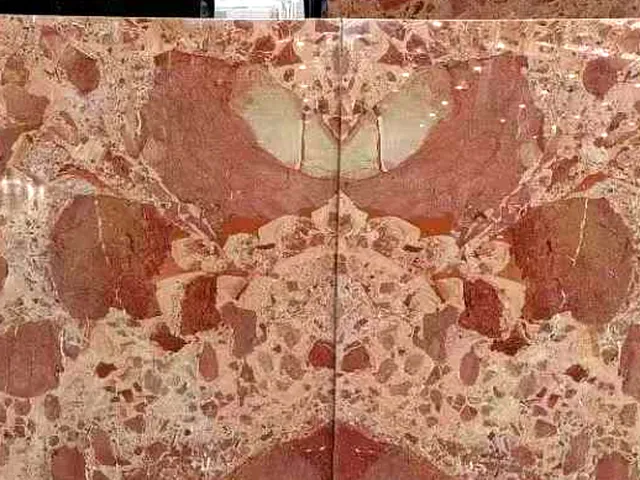
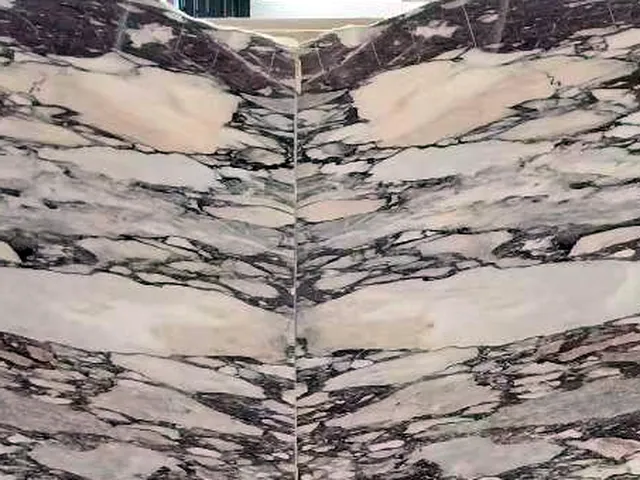
It is an Italian marble with a light background, between cream and pearl grey, with large wine-red, rust and grey veins and fragments. It is a breccia: a stone made of rock fragments that broke apart and naturally bonded together again. The coloured veins mark the edges of those fragments, which is why its pattern is so irregular and expressive. See our natural stone glossary.
Like all marble it is made mostly of calcite: it polishes beautifully, but acids affect it.
Every slab is different
In Breccia Pontificia the amount of red varies a lot from slab to slab: some have a few bold red veins over plenty of light background, others have the colour spread more evenly. That is why you should:
- Choose the actual slab from a photo of the whole slab. You can see real slabs on our Breccia Pontificia page.
- Check the pores and the joins in the breccia. It is normal for them to be resin-filled at the factory; what matters is that they are well finished.
- Decide where you want the red before cutting: on a fireplace or a wall, the main veins should sit at the centre of the view.
The bookmatched V
It is most striking bookmatched. Two consecutive slabs from the same block, opened like the pages of a book, make the red veins meet at the joint and draw a large V. To get it right:
- Ask for consecutive slabs from the same block and confirm that they are.
- Plan where the axis of symmetry goes: on a wall, at the centre; in a bathroom, behind the basin or the bath.
- Ask your fabricator to draw the layout on the photo of each slab before cutting.
More detail in what is bookmatching.
Where to use it
- Bathrooms with a stone feature wall, especially bookmatched. See marble in the bathroom.
- Fireplaces, one of its classic uses. Ideas in marble fireplace.
- Headboards, receptions and feature walls in hotels and restaurants.
- Tables and signature pieces, where a single slab is enough.
For a hard-working kitchen, think twice: as a marble, lemon, vinegar or wine leave dull marks and it develops a patina over the years. If you like that look, go for it.
What it pairs with
- Brass and gold, which pick up the rust tones in the veins.
- Walnut and off-white or cream walls, which give the pattern room to breathe.
- In a bathroom, a plain light floor, with a single wall as the star.
Care
- Keep acids away: lemon, vinegar, wine or limescale removers leave a dull mark, even on sealed stone. See marble etching.
- Seal it when installed and do the water-drop test from time to time.
- Clean with water, pH-neutral soap and a soft cloth.
- If the shine fades over the years, a stone fabricator can re-polish it.
How much does it cost?
It is a high-end marble. The price depends on the actual slab (above all its pattern and how much red it has), its size, thickness and destination, and it changes with the market, so a fixed figure would soon be out of date. The most reliable approach is to ask about the slabs available: we will send you photos and a price for real slabs. We sell the whole slab; your fabricator does the cutting.
Similar stones
If you are after a marble with red or burgundy veins, our library also has Breccia Rosso, Calacatta Viola, white with burgundy and violet veins, and Rosso Lepanto. The similarity is visual: ask us about each one. We compare them in pink and red marble.
Are you an interior designer or architect? How we work with design studios · Contractor or fabricator? Trade supply