Calacatta Viola Marble
Calacatta Viola is an Italian marble with a white background and burgundy and violet veins and fragments. Every slab is unique and, book-matched, they create symmetrical patterns with enormous impact. Used in bathrooms, islands and feature walls.
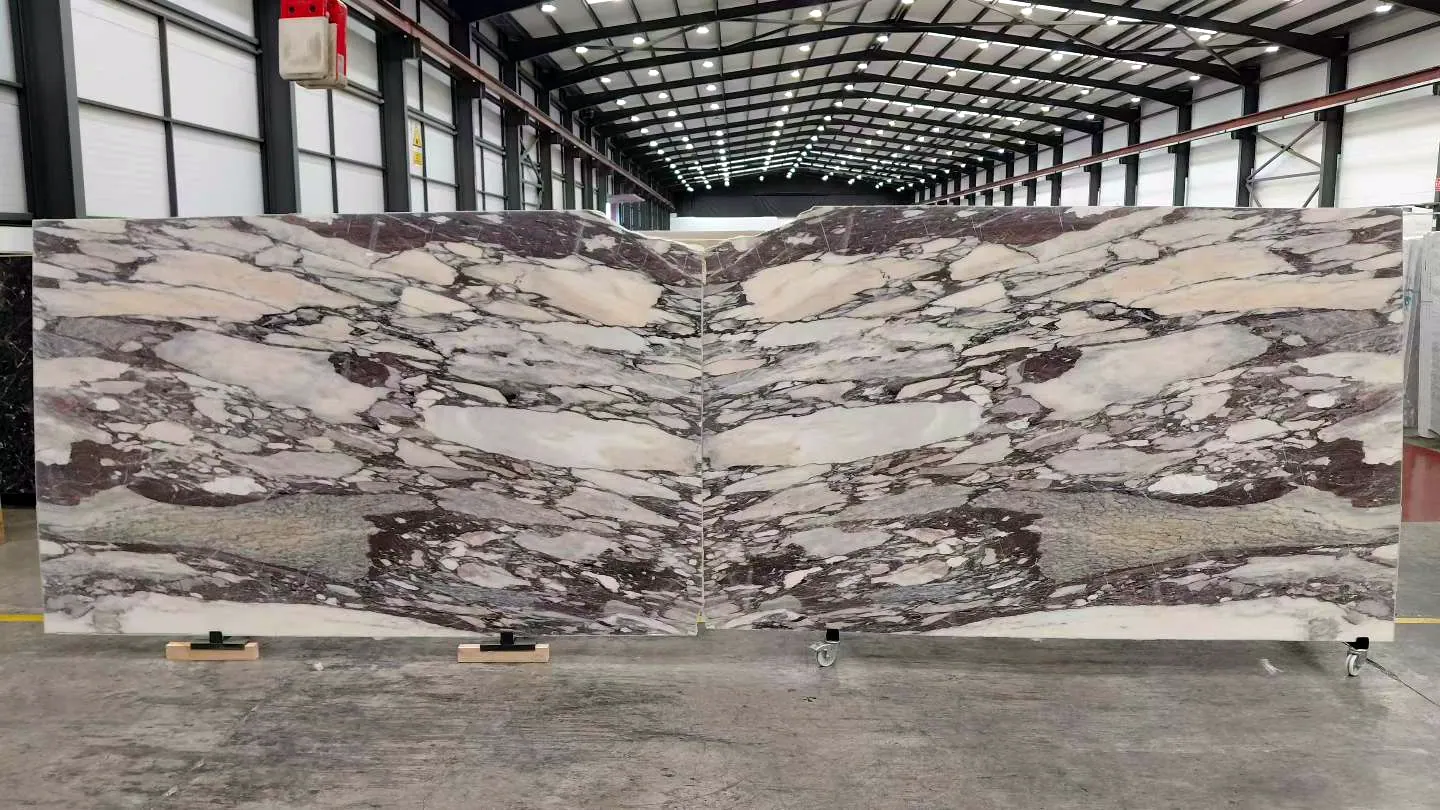
Reference image of a real slab. We confirm the batch, dimensions and availability before your order. Download the photo (for your moodboard)
- TypeMarble
- ColourViolet
- OriginItaly
- FinishesPolished
- PriceDepends on material, batch, format, quantity and destination
- AvailabilityAsk us about slabs in stock
- ShippingWorldwide
- Sold asWhole slab (your fabricator cuts it)
- See it in personWarehouse in Llanera de Ranes (Valencia), by appointment via email
About this marble
Properties
A metamorphic rock made mostly of calcite. Luminous, with unique veining and easy to re-polish. Hardness 3–4 on the Mohs scale.
Recommended uses
Bathrooms, floors, stairs, cladding, fireplaces, tables. In kitchens, if you are happy for it to develop a patina.
Care
Sensitive to acids (lemon, vinegar) and slightly porous: it should be sealed and cleaned with pH-neutral soap.
What Calacatta Viola looks like
It is an Italian marble from the Calacatta family, but with a personality all its own: across the white background run burgundy and violet veins and fragments, giving it a breccia-like pattern. No two slabs are alike. In some, white dominates and the violet appears as scattered veins; in others, the veining is so dense it almost covers the slab.
When choosing your slab, look at three things:
- The balance of white and violet. It changes the whole mood: more white feels brighter, more veining feels more dramatic.
- The shade of the veins. It ranges from deep burgundy to a lighter violet, so ask for photos of the slab taken in daylight.
- Consecutive slabs. To book-match, you need slabs cut one after another from the same block. See what is book-matching.
Where it works best
It shines in pieces that are looked at more than worked on: a book-matched wall behind the bath, a vanity top, a fireplace surround, a kitchen backsplash or the front of an island. On a hard-working kitchen countertop, let's be honest: it is marble, and lemon juice or wine will leave dull etch marks that show up on the white. If you have your heart set on it for the kitchen, use it for the backsplash or the island and keep a harder stone for the area where you cook and prep.
What to pair it with
This is a statement stone, so everything else should play a supporting role:
- Warm metals: brass, bronze or brushed gold bring out the burgundy tones.
- Wood in walnut or dark oak, with walls in off-white, taupe or deep green.
- Fabrics in velvet and shades of wine, plum or dusty pink if you want to play up the violet.
- No other heavily veined stones in the same room: they end up competing.
Similar stones
- Lilac: also a white background with lilac and violet veins, but softer. Delicate rather than dramatic.
- Dover White and Bossa Nova: a breccia pattern on white, with the violet mixed with grey (and with gold in Bossa Nova). For the same effect with less colour.
- Calacatta: the classic white with bold grey veins, if you decide not to take the plunge on colour.
Real stone or imitation?
"Calacatta Viola" is also the name of plenty of porcelain and quartz surfaces. Three quick clues: no two slabs of the natural stone are the same, the veining runs right through the thickness and shows on the edge, and up close the violet has depth and crystals. A printed pattern looks flat and repeats. We explain more in natural stone or imitation.
Every Calacatta Viola slab is different, so it pays to choose your own: ask us for photos and videos of the slabs available and we can reserve the one you like. We ship worldwide.
Related guides: Types of Calacatta marble: Oro, Viola, Borghini, Macchia Vecchia and more · Pink, red and purple marble: types and how to choose · Marble kitchen countertops: pros, cons and how to live with them · How to clean marble (and what never to use) · How to remove stains from marble: coffee, wine, oil, rust and hard water · Marble etching: what it is, why it happens and how to fix it · Do you need to seal marble? When, how often and how to do it · Marble vs quartzite: the real differences for countertops
Interested in Calacatta Viola?
Add it to your selection with any others you are considering, or ask for a quote now. We will reply with today’s price and the available slabs.
Other stones with a similar appearance
Visual similarity does not imply the same composition, care or applications.