Carrara vs Calacatta marble: how to tell them apart at a glance
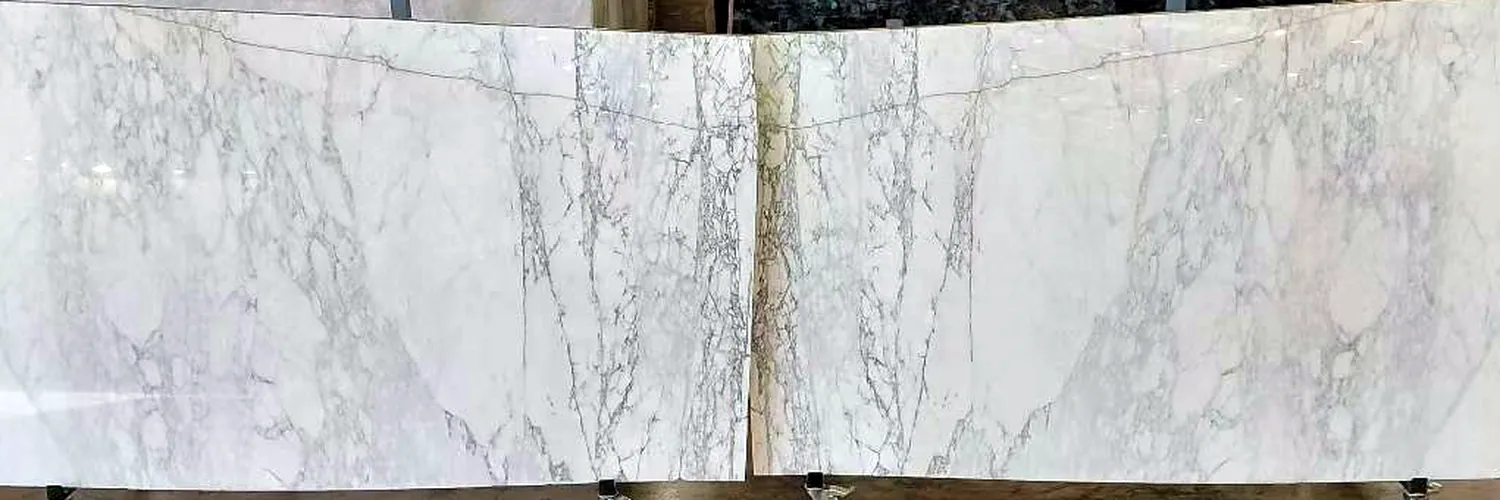
Both are white Italian marbles from the same mountains, and in a small photo they are easy to confuse. In a kitchen or a bathroom, though, they look very different. Here is how to tell them apart.
Same origin, different stone
Carrara and Calacatta both come from the Apuan Alps around the town of Carrara, in Tuscany. There are hundreds of quarries there, and each area yields a different marble:
- Carrara is the most plentiful: there is a lot of it, from many quarries.
- Calacatta comes from very few quarries, in smaller quantities. That scarcity explains much of its price.
How to tell them apart at a glance
| Carrara | Calacatta | |
|---|---|---|
| Background | Greyish or bluish white | Bright, luminous white |
| Veining | Fine and soft, feathery or like pencil lines | Thick and bold, with lots of movement |
| Vein colour | Grey | Dark grey, often with gold or beige tones |
| Contrast | Low: overall it reads as light grey | High: dark veins on a very white background |
| Consistency | Fairly uniform from slab to slab | Every slab is very different |
The quick trick: step back a couple of metres. If the stone looks light grey overall, it is Carrara. If it looks white with big veins that stand out, it is Calacatta.
What about Statuario?
It is the third member of the trio. Statuario has a very white background like Calacatta, but its veining is usually grey, crisper and less golden. It is also rare and sits at the high end. We cover the varieties in types of Calacatta.
Which one costs more?
Calacatta, by a wide margin, because of its scarcity and its demand in luxury projects. Carrara is the most accessible Italian white marble. In both cases the exact price depends on the specific slab and changes with the market.
Do they perform the same?
Yes. Both are calcite marbles, so:
- Acids (lemon, vinegar, wine) leave dull etch marks.
- They absorb liquids unless they are sealed.
- They can be re-polished to look like new.
One practical advantage of Carrara: with its greyish background and fine veining, it hides everyday wear better than the bright white of Calacatta.
Where each one works best
- Carrara: large surfaces, floors, whole bathrooms and kitchens where you want the Italian marble look on a sensible budget.
- Calacatta: statement pieces: an island, a book-matched wall, a main bathroom. It is a stone that is meant to be seen.
Beware of the names
"Carrara" and "Calacatta" are also the names of many quartz and porcelain designs. A "Calacatta" quartz is not marble: it is a manufactured material that imitates its pattern. We explain how to tell them apart in natural stone or imitation.
Can't decide? Ask us for photos of real slabs of each and compare them yourself.
Have a project in mind?
Ask us for a no-obligation quote: we will reply with an indicative price.