Natural stone or imitation? How to tell a real Calacatta, Taj Mahal or Statuario
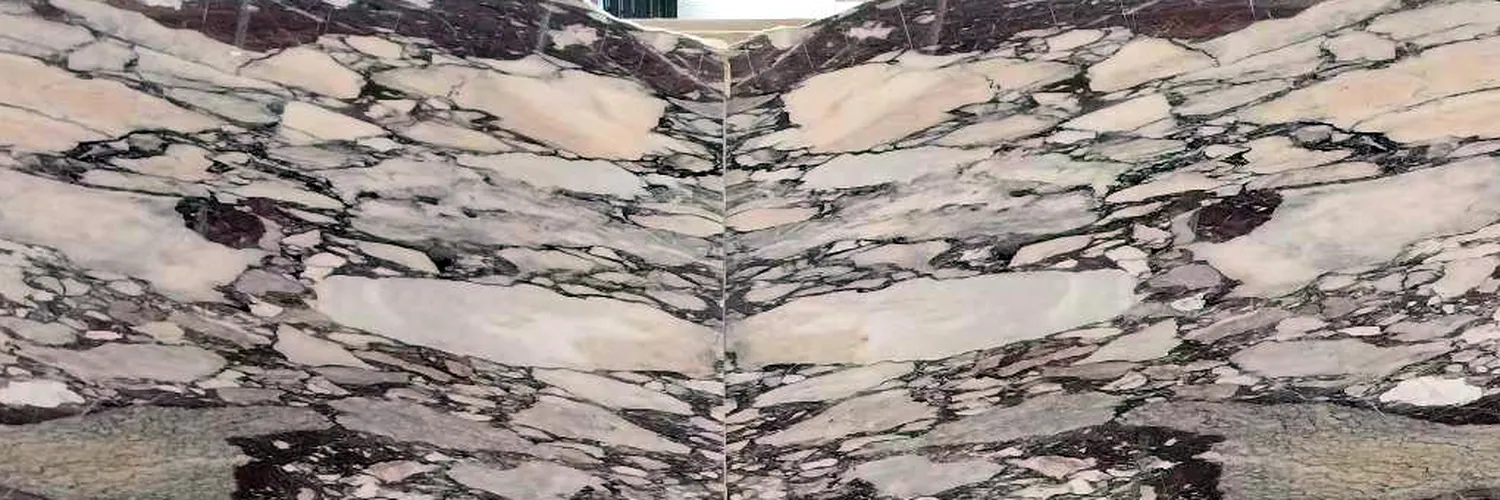
Search for "Calacatta Viola" or "Taj Mahal" and you will find porcelain, quartz and sintered stone with the same names. That is no accident: they imitate natural stone. Here is how to tell them apart and what each one offers.
Why they share the same names
Surface manufacturers name their designs after the stone they imitate. So there are quartz "Calacattas", porcelain "Statuarios" and sintered "Taj Mahals". They fall into three types:
- Porcelain and sintered stone (for example Neolith, Laminam, Dekton or Porcelanosa's large formats): ceramic fired at very high temperature, with the pattern printed on.
- Engineered quartz (for example Silestone): crushed quartz bound with resin, with the pattern added during manufacturing.
- Natural stone: a slab cut from a quarry block. It is the only one that really is a Calacatta Viola marble or a Taj Mahal quartzite.
How to tell them apart in the showroom
- Look for repeats. A printed pattern repeats every so many pieces or slabs. No two natural stone slabs are the same.
- Check the edge. On many porcelain products the pattern is only on the surface and the edge is a different colour. In natural stone the veining runs through the whole thickness.
- Look closely and against the light. Stone has depth: crystals, tiny pores, translucent areas. A print looks flat.
- Check the back. A natural slab may have reinforcing mesh and resin. Porcelain has a uniform back.
- Ask directly: "Is it natural stone? Which quarry does it come from? Can I see the actual slab?" If they cannot tell you, it probably is not.
What each one offers
| Natural stone | Porcelain / sintered | Engineered quartz | |
|---|---|---|---|
| Pattern | Unique in every slab | Printed, repeats | Manufactured, fairly uniform |
| Depth | Real: crystals, translucency | Flat | Flat |
| Durability | Depends on the stone: marble is delicate, quartzite very hard | Very resistant to stains and acids; edges more prone to chipping | Stain resistant; the resin does not like direct heat |
| Repair | Can be re-polished to look new | Chips are hard to repair | Repairs are only so-so |
| Backlighting | Yes, with onyx and translucent stones | No | No |
If an engineered quartz surface is cut on site, bear in mind that its dust is very high in silica. That is why fabricators cut it wet and with respiratory protection.
So which should you choose?
- An imitation makes sense if you want a uniform pattern, a lower price and minimal worry.
- Natural stone makes sense if you want a one-off piece with real depth, that can be re-polished over the years and that nobody else has. With boldly patterned stones like Calacatta Viola, the difference is striking.
If you want the marble look with the toughness of natural stone, see quartzite that looks like marble. And if you are torn between marble and porcelain, we compare them in depth in marble vs porcelain.
Every photo in our catalogue is of a real slab. You can see the real Taj Mahal, Statuario or Calacatta Viola.
Have a project in mind?
Ask us for a no-obligation quote: we will reply with an indicative price.