Dolomite vs quartzite: how to tell them apart before you buy
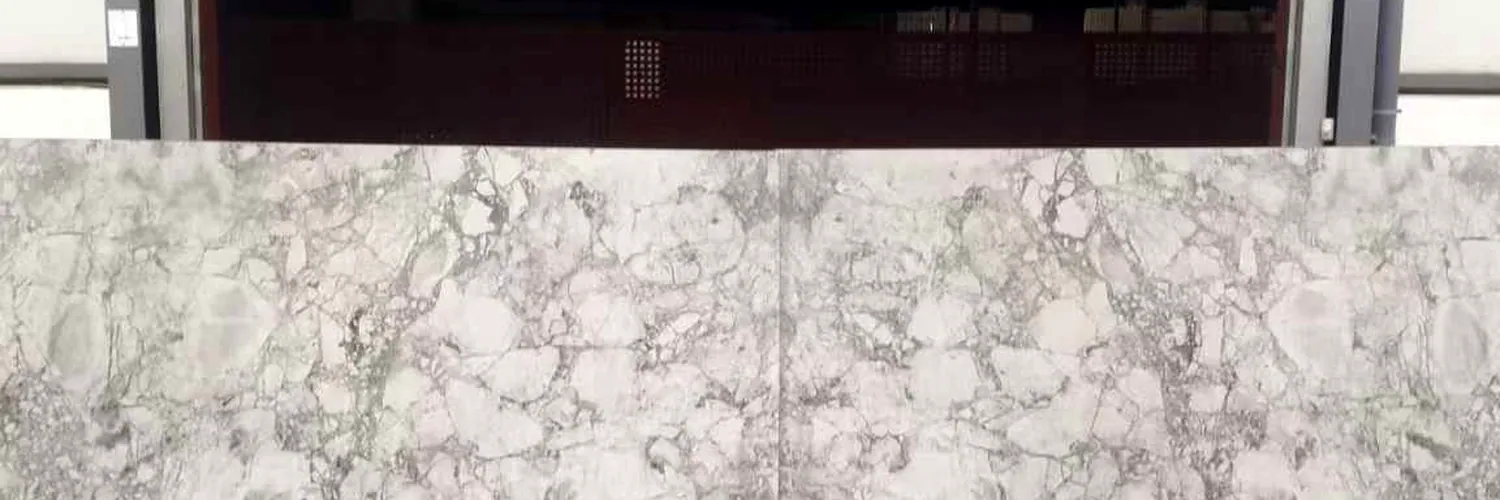
Two white slabs with grey veins, both sold as "quartzite". One shrugs off a knife and a squeeze of lemon; the other does not. Chances are the second one is dolomite. It is not a worse stone, but it behaves differently, and you want to know that before it becomes your kitchen countertop (worktop).
What dolomite is
Dolomite is a mineral: a calcium magnesium carbonate. Strictly speaking, a rock made mostly of it is also called dolomite (or dolostone), and once it has been recrystallised by heat and pressure, like marble, it is a dolomitic marble. In the stone trade the terms are used almost interchangeably.
Compared with ordinary marble, which is made of calcite:
- It is slightly harder: around 3.5–4 on the Mohs scale, against 3 for calcite.
- It still reacts with acids, only more slowly. Lemon and vinegar will etch it, usually later and more faintly than a calcitic marble.
- It takes a beautiful polish and often has a very white background with grey veins, much like some white quartzites.
Quartzite, by contrast, is almost all quartz, which rates 7 on the Mohs scale and does not react with kitchen acids.
Marble, dolomite and quartzite side by side
| Calcitic marble | Dolomite (dolomitic marble) | Quartzite | |
|---|---|---|---|
| Main mineral | Calcite (calcium carbonate) | Dolomite (calcium magnesium carbonate) | Quartz (silica) |
| Approx. Mohs hardness | 3 | 3.5–4 | 7 |
| Scratches glass? | No | No | Yes |
| Scratched by a knife? | Yes | Yes, with a bit more effort | No |
| Lemon and vinegar | Dull etch mark within minutes | Dull etch mark, more slowly and often fainter | No effect |
| In a kitchen | Develops a patina with use | Fine with care: treat it like marble | The toughest of the three |
Why dolomite gets sold as "quartzite"
It is not always bad faith. There are a few reasons:
- They look alike. A white dolomite and a white quartzite can be almost identical in a photo, and even in front of the slab.
- "Quartzite" sells. Since quartzite became famous for its toughness, some stones are marketed under that name. You will also hear "soft quartzite", a term that does not exist in geology: if it is soft, it is not quartzite.
- Stone names are trade names. A name does not guarantee what the stone is made of, and the same stone can vary from one block to the next.
It happens mostly with white and light grey stones. So rather than trusting the name, test the actual slab, including any of ours. For white quartzites with a marble look, see quartzite that looks like marble.
How to check: two home tests
Do them on a sample or an offcut of the stone, never on a countertop that is already installed.
1. The glass test
- Take a glass tile, an old mirror or a glass bottle.
- Drag a sharp edge of the sample firmly across the glass a few times.
- Wipe it with your finger and look against the light. If there is a groove you can feel with a fingernail, the stone scratches glass: it is quartzite. If there is only a powdery trail that wipes away, it does not: it is marble or dolomite.
Glass has a hardness of about 5.5, so quartz scratches it and dolomite does not.
2. The lemon (or vinegar) test
- Put a few drops of lemon juice or vinegar on the polished face.
- Leave them for at least 10–15 minutes. Because dolomite reacts more slowly, leave another drop for up to half an hour.
- Rinse, dry and look against the light. A dull mark or a spot that has lost its shine means calcite or dolomite: treat the stone like marble.
Test in several spots, because a slab can have veins of other minerals. If one test says one thing and the other says the opposite, ask before you decide.
What to ask the seller
- Is it quartzite, dolomite or marble? And what is that based on: a lab analysis or just the trade name?
- Is there a technical data sheet with density and water absorption (EN 1936 and EN 13755 tests)?
- Can I test a sample of this same stone?
- What would you recommend it for: a kitchen countertop, a bathroom or a wall?
A good supplier will not mind these questions. We will tell you honestly what we know about each stone and send you photos and videos of the actual slab.
When dolomite is a good choice
Dolomite is not a second-rate "fake quartzite": it is a beautiful stone, often very white, and slightly harder than calcitic marble. You just need to choose it knowing what it is.
- Bathrooms: vanity tops, walls and floors. Avoid acidic and descaling cleaners (more in marble in the bathroom).
- Walls and cladding, fireplaces and furniture that sees light use.
- Kitchens, with care: if you accept some patina, wipe up lemon, vinegar and wine straight away and reseal when needed (see sealing). A honed or leathered finish hides etching better than a polished one (see finishes).
If you want a countertop you never have to think about, look for a quartzite that passes both tests: the families are in types of quartzite, and the comparison with marble is in marble vs quartzite. And if it has already etched, marble etching explains how to fix it.
Unsure about a particular white stone? Tell us how you plan to use it and we will send you photos and videos of the real slabs, along with what we know about each one. We ship worldwide.
Have a project in mind?
Ask us for a no-obligation quote: we will reply with an indicative price.